
Checking Criminal History in Kansas City
Kansas City criminal records start in different places. A KCPD report answers what officers documented. A municipal docket shows a city ordinance or traffic case. A Clay County court file shows a state charge filed from the Northland part of Kansas City. MACHS, the Missouri repository service, answers a broader state history question. Match the source to the event before searching.
A name alone is rarely enough. Gather the approximate date, location, report or case number, and the type of event. For a police request, KCPD calls its report identifier the CRN. For court work, the exact case number is the best key. Use this order:
- Ask KCPD Records for the incident, arrest, or media record created by Kansas City officers.
- Use the Kansas City Municipal Court route for a city citation, ordinance allegation, or traffic matter.
- Check Missouri Case.net under Clay County when the event became a state criminal prosecution in Clay County.
- Check the Clay County detention channel when the question is current or recent county custody.
- Use MACHS only when a Missouri repository history, rather than one Kansas City file, is needed.
The broader Clay County criminal history overview explains county and state channels in depth. At Kansas City altitude, the key is to identify the city record first.
Kansas City Court Record Mismatch
Kansas City spans county lines. That fact creates an unusual search rule for city court records. For a Kansas City ordinance event in the Clay County portion, the city directs Case.net users to select Jackson County, 16th Circuit, then choose Kansas City Municipal. Selecting Clay County simply because the event occurred north of the river can hide the municipal result a reader expects.
This does not move a Clay County state prosecution to Jackson County. It is a routing rule for the Kansas City Municipal Court system. A felony or state-law misdemeanor filed from the Clay portion still belongs in the Circuit Court of Clay County, Seventh Judicial Circuit. Read the charging authority on the ticket or case header before deciding which court owns the record.
Note: The city court routing rule is about Kansas City municipal cases, not all criminal records created within Kansas City’s Clay County area.
Kansas City Police Department Records
The Kansas City Police Department keeps the original report made by its officers. KCPD Records is at 1125 Locust Street, Kansas City, Missouri 64106, and the main records phone is 816-234-5100. A sheriff file is not a substitute. Even if a person later enters the Clay County jail, the city police narrative remains with KCPD.
The public request form asks for requester and contact details, address and date of birth, the requester’s interest or relationship, and facts that identify the incident. Those facts include CRN, date, time, location, and event type. Separate boxes identify reports, photographs, audio, video, and other media. Signature, date, routing, and agency cost fields complete the form.
KCPD Records
1125 Locust Street
Kansas City, MO 64106
816-234-5100
Kansas City Police Request Fields
A focused KCPD request can reduce follow-up. The form is built around the CRN and event facts, not a broad demand for everything tied to a name. If the CRN is unknown, supply the closest date, time, place, and event type that can identify the Kansas City record. Describe the exact medium needed because a paper report and body-camera video follow different work paths.
| Identity fields | Requester or company, contact details, address, and date of birth |
|---|---|
| Interest fields | Reason, litigation, relationship, and depicted-person choices |
| Event keys | CRN, date, time, location, and incident type |
| Record choice | Report, audio, video, photographs, or other requested material |
| Delivery account | User name, email, phone, mobile number, justification, and password fields |
KCPD reports typically take four to six weeks. Audio and video can take longer, and quoted costs must be prepaid. A narrow description is especially useful when media review adds to the wait.
Kansas City Arrests and Bookings
A Kansas City arrest can create several records at once. KCPD creates the incident and arrest report. A detention facility creates a custody file if booking occurs. Fingerprints and arrest data may reach the Missouri State Highway Patrol repository. A court record appears only if a prosecutor files a charge. Each record can show a different stage and a different charge description.
For a recent Northland arrest, start with KCPD for the police report and the Clay County detention listing for county custody. The county list is browse-only and refreshes every four hours. An empty court result right after arrest does not prove that no arrest occurred because filing can come later. Likewise, absence from current custody does not erase a prior booking.
Once a Clay County state charge is filed, the public case file can be followed through Clay County criminal court cases. Kansas City municipal allegations stay on the separate city route.
Kansas City CRN Record Timeline
The KCPD CRN anchors the city police side. It does not become the court case number. After an arrest, the police report and any booking file exist before a prosecutor decides whether to charge. A municipal prosecutor may pursue a city ordinance allegation, while the Clay County Prosecuting Attorney handles a state charge filed in the Seventh Judicial Circuit.
Local record timeline: KCPD CRN › booking or release › municipal or county charging decision › court case number › disposition reported to MSHP CJIS.
Keep both identifiers if the matter reaches court. The CRN helps KCPD find the source report and media. The case number helps the clerk find hearings, filings, judgment, and sentence. A dismissal on the court side does not, by itself, erase the police report or booking file.
Municipal Court Records in Kansas City
Kansas City Municipal Court is at 511 East 11th Street. The clerk can be reached at 816-513-2700 or court@kcmo.org. Regular hours are weekdays from 8 a.m. to 5 p.m., with hours extended to 6:30 p.m. on the first Wednesday. The court handles Kansas City ordinance and traffic matters, not Clay County felony prosecutions.
| Court name | Kansas City Municipal Court |
|---|---|
| Case types | Kansas City ordinance and traffic cases |
| Current lookup | Case.net under Jackson County, 16th Circuit, then Kansas City Municipal |
| Older lookup | MuniCourt.net for cases before November 6, 2023; some pre-August 28, 2011 files may be off-site |
| Copies | $1.50 for the first page, $0.10 for each added page, and $2 for certification |
A docket can show the city case number, charge, scheduled events, disposition, and judgment data that are public. It does not replace the KCPD narrative.
Kansas City Court Record Migration
Kansas City changed its municipal search path on November 6, 2023. Current city cases moved to the Case.net route, while earlier cases remain in MuniCourt.net. Very old material can require direct clerk help because cases before August 28, 2011 may be stored off-site. One failed online search is therefore not the end of a sound Kansas City record check.
Use the event date to choose the first system. If the case falls near the migration date, check the clerk’s guidance and preserve any known ticket or case number. For off-site material, state the name, approximate year, citation information, and the exact copy or certification needed. That gives staff a much narrower Kansas City records task.
Dismissed municipal cases can also be confidential under the applicable access rules. An absent result may reflect age, migration, off-site storage, or a lawful confidentiality rule.
Where Kansas City Records Go
Kansas City records do not merge into one public file. KCPD remains the custodian of its report. The municipal clerk holds city cases. Clay County’s circuit clerk holds state criminal cases filed from the Clay portion. MSHP CJIS receives reported arrest fingerprints and later dispositions for the central Missouri history.
Record flow: Kansas City Police Department › Kansas City Municipal Court or Clay County Courts › Missouri State Highway Patrol CJIS.
Recent activity is usually clearest at the source: KCPD for the event, the jail for custody, or the city clerk for a municipal citation. An older completed case is better traced through its court docket and disposition. MACHS is broader, but the public name product returns possible matches and only Missouri records open under state law.
Kansas City Federal Court Records
Federal prosecutions are a different layer. Clay County lies in the U.S. District Court for the Western District of Missouri, and federal dockets are searched through PACER rather than Case.net or the Kansas City Municipal Court. The Western District’s Kansas City courthouse is the nearest federal records venue.
The Western District of Missouri provides the official court location and procedure source. Its public-facing court image below helps distinguish the federal channel from Kansas City’s city and county paths.
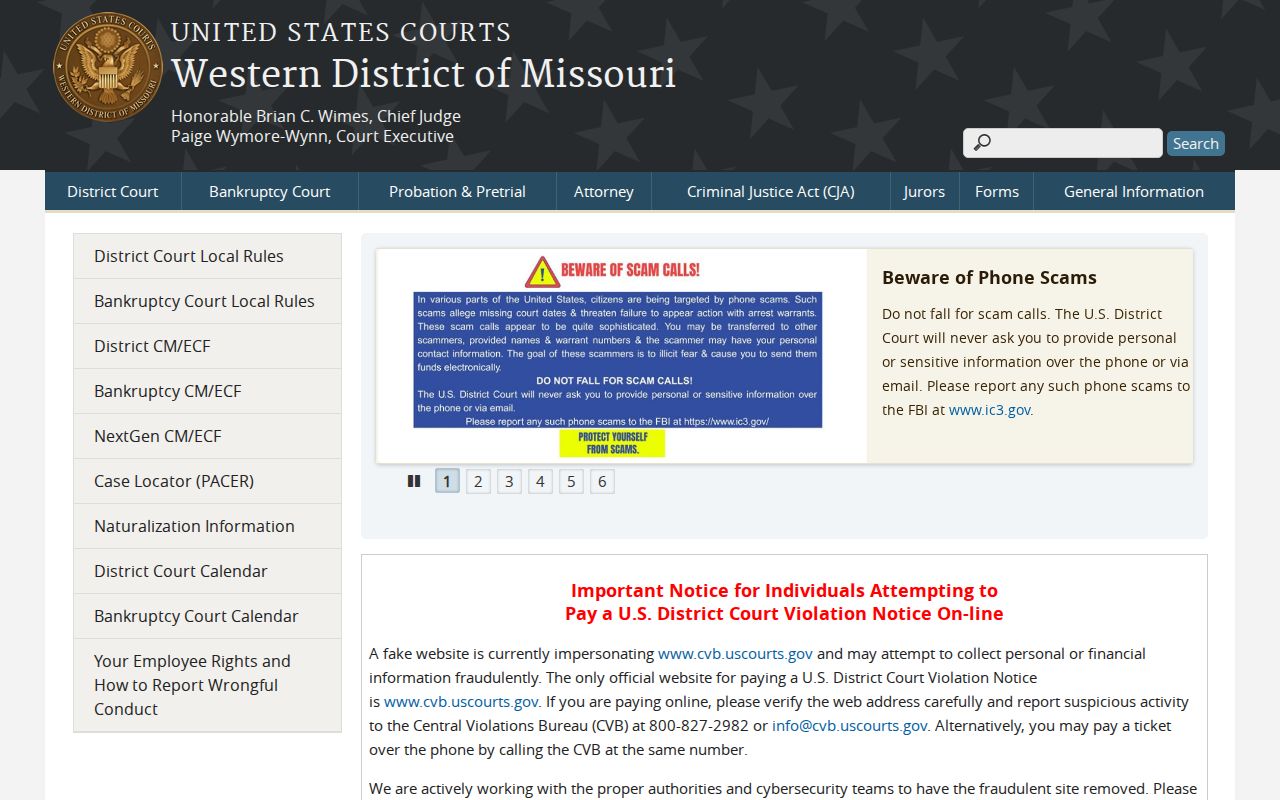
This federal court source matters only when the charge was brought by the United States. It does not contain routine Kansas City ordinance cases or Clay County state prosecutions.
Kansas City Court Record Costs
Kansas City municipal copies have a documented fee pattern. The first page costs $1.50, each added page costs $0.10, and certification costs $2. Certification is useful when the reader needs the clerk to attest that the copy is an official court record. It does not change what part of a file is public.
KCPD media requests follow a different path. The department quotes the cost after reviewing the request, requires prepayment, and warns that audio or video can take longer than the usual four-to-six-week report window. Do not apply the court’s page rate to police media or assume that payment overrides a closure or redaction required by law.
Ask for an estimate and state whether an ordinary copy or certified court copy is needed. That small distinction keeps Kansas City criminal record requests precise.
Public Access Rules in Kansas City
The Missouri Sunshine Law applies to Kansas City police records, while Missouri court access rules govern court files. The custodian can redact protected details from an otherwise open record. Initial incident and arrest information is generally open, but investigative material begins closed and can remain restricted while active. Confidential parties, juvenile material, sealed records, and protected attachments are not made public merely because another part of the case is open.
Key statutes and rules:
RSMo §610.010 defines Missouri public records.
RSMo §610.100 sets access lines for incident, arrest, and investigative reports.
RSMo §610.120 limits access to records closed under Chapter 610.
Court Operating Rule 2 governs public access and confidentiality in Missouri court records.
Ask the office that created the record. KCPD answers for its report, the city clerk for Kansas City municipal records, and the Clay County circuit clerk for a state court file.